

In Aldi Foods Pty Limited v Hampden Holdings I.P. Pty Limited, the Full Federal Court clarified how to assess whether artistic works have been substantially reproduced where a competitor emulates a competitor’s packaging. Rejecting an approach built on abstracted “look and feel” elements, the Full Court required a side-by-side comparison of each pair of works informed by evidence of originality and found that five of Aldi’s eleven MAMIA packaging designs infringed.
Background
The respondents (together, Hampden) own copyright in the artistic works appearing on the packaging of their baby and child snack range sold under the marks BABY BELLIES, LITTLE BELLIES and MIGHTY BELLIES (Hampden Works).[1]
Aldi, through its design agency Motor Brand Design, developed packaging for its MAMIA snacking range (Aldi Works) using the Hampden Works as its “benchmark”.[2] Aldi instructed its designers to “follow the architecture” of the Hampden Works; a draft which received feedback that it was “too close to our benchmark” was then altered to be slightly less similar.[3] The primary judge inferred that the aim was for the Aldi Works to resemble the Hampden packaging, “albeit not too closely, because that would infringe the law”.[4] This was found to be “part of a deliberate strategy to create packaging for its own products that resembled the packaging of its competitor”.[5] However, on appeal it was confirmed that intention will not assist an alleged infringer if substantial reproduction is established objectively.[6]
At first instance, the primary judge divided the Aldi Works into non-puffs works (Aldi Non-Puffs Works) (items 1–8) and puffs works (Aldi Puffs Works) (items 9–11).[7] His Honour held that the Aldi Puffs Works infringed, but the Aldi Non-Puffs Works did not.[8] Aldi appealed the infringement findings and the award of additional damages, and Hampden cross-appealed the findings of non-infringement.[9]
Primary judgment
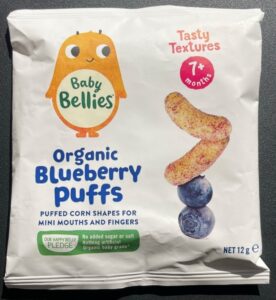
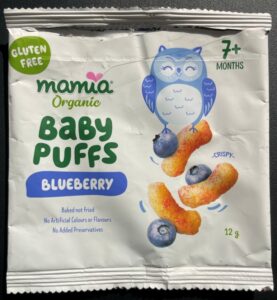
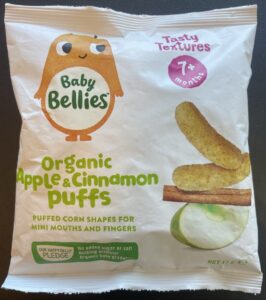
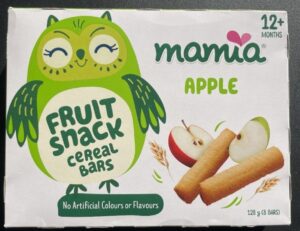
The primary judge considered 11 Aldi Works products, assigning a number to each product (items 1–11); items 9, 10 and 11 of the Aldi Works were found to infringe each of items 1, 6 and 7 of the Hampden Works, respectively,[10] as set out below.[11] On appeal, the Full Court considered it unnecessary to have regard to every possible pair as there are 99 possible pairs.[12]
| Item 1: Blueberry Puffs Hampden Work
|
Item 9: MAMIA Baby Puffs Blueberry Aldi Work
|
| Item 6: Apple & Cinnamon Puffs Hampden Work
|
Item 10: MAMIA Fruit Snack Cereal Bars Apple Aldi Work
|
| Item 7: Organic Carrot Puffs Hampden Work
|
Item 11: MAMIA Baby Puffs Carrot Aldi Work
|
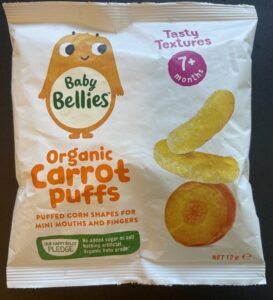
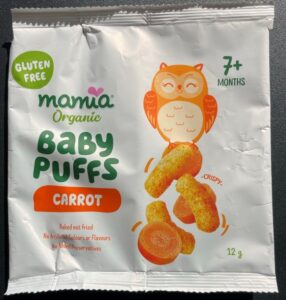
The primary judge also reduced the Hampden Works to lists of “layout and design elements” such as “a small oval-shaped cartoon character, with a large, light-coloured belly”, “a solid white background”, and “a two-column layout”,[13] which constituted a substantial part of item 1 of the Hampden Works.[14] His Honour then asked whether each element was present in the relevant Aldi Works.[15]
On appeal, the Full Court held that the primary judge adopted an incorrect approach.[16] Describing elements at that level of generality risked abstracting away, and so overlooking, differences between the works.[17] The Full Court also emphasised that the assessment is not a binary question of whether a feature is present, but one of the degree of similarity.[18]
A proper analysis instead requires a side-by-side comparison of each relevant pair of works, having regard to all similarities and differences, together with the originality of the copyright work.[19] Per Designers Guild,[20] the question is whether what has been taken forms a substantial part of the copyright work.[21]
Originality
Following IceTV, the quality of what is taken, and particularly its originality, is critical.[22] The primary judge had not completely overlooked originality;[23] however, his Honour assessed originality by impression, without engaging with evidence of the iterative design process or with Aldi’s evidence of elements said to be commonplace in the market.[24] Where such evidence is adduced, failing to consider it may amount to a failure to properly consider originality.[25] This is because it attempts to generalise a “look and feel” across multiple different artistic works.[26] In the appeal, their Honours considered this approach to be unhelpful as it distracted from the correct analysis.[27]
The Full Court also cautioned that describing elements as “commonplace” at too high a level of generality (such as a “playful childlike character”) can obscure what is distinctive.[28] While features such as a white background or age indicator carried little weight when considered in isolation, there was no evidence of any other packaging combining the particular features that Aldi had replicated.[29]
Copyright does not protect “look and feel”
Hampden had run its case on a common “look and feel” shared across all of its works. The Full Court rejected this as an incorrect approach, observing that copyright does not protect a style or get-up.[30] Such an approach attempts to generalise a “look and feel” across multiple different artistic works, and distracts from the correct analysis.[31] The Full Court upheld Elwood,[32] rejecting Aldi’s challenge to it, but confirmed that Elwood does not assert that copyright prevents appropriation of a trader’s “look and feel”; copyright protects “look and feel” only to the extent it is embodied in identifiable elements of expression in a particular work.[33] Deriving a “look and feel” from multiple works is an exercise better suited to misleading or deceptive conduct claims.[34]
Reconsideration and outcome
In reconsidering the infringement, the Court held that each Aldi Puffs Work infringed its flavour-matched Hampden counterpart, largely because of the strikingly similar photographs of ingredients and product, the shared colour palette, the childlike font and the cartoon character’s distinctive belly.[35] However, that reasoning did not extend across flavour varieties, so the primary judge’s broader declarations were narrowed.[36]
As for the Aldi Non-Puffs Works, items 4 and 6 were found to be “just” sufficient to reproduce a substantial part of Hampden’s blueberry puffs work, driven by the cream belly with green writing, the orange character (item 4), and the blueberries and blue elements (item 6).[37] Therefore, a total of five Aldi Works products infringed and the remaining six did not infringe; seemingly minor variations, such as a green or pink owl in place of an orange one, placed those works on the “right side of the line”.[38]
Hampden’s own litigation approach also impacted the results. For several Aldi Works, the closest comparator was Hampden’s apple and cinnamon puffs work, which Hampden had abandoned as a comparator on its cross-appeal, confining comparators to Hampden Works items 1 and 3.[39]
Additional damages
The Full Court upheld the primary judge’s finding of flagrancy under s 115(4) of the Copyright Act 1968 (Cth). By deliberately emulating a competitor’s designs for commercial advantage when it could have used packaging of its own design, Aldi courted the risk that any infringement would attract additional damages.[40] That finding now extends to the two additional infringing works (Aldi items 4 and 6).[41]
Takeaways
This decision confirms that copyright infringement in artistic works turns on a work-by-work comparison, not on a brand’s overall aesthetic. Rights holders should nominate the one or two closest comparator works for each allegedly infringing item, and deploy evidence of originality in the infringement analysis, not merely on subsistence. Where the real complaint is range-wide resemblance, claims under the Australian Consumer Law or in passing off may be more apt.
For retailers, the decision is a cautionary tale on the risk of “benchmarking” strategies. Emulation with modifications can still infringe, and a deliberate strategy of staying “not too close” may nevertheless attract additional damages if the line is crossed. As the outcome here shows, that line may turn on details as fine as the colour of an owl.
Piper Alderman has a nationally recognised intellectual property and technology team, with experience in copyright and trade mark litigation. Please contact Tim O’Callaghan and the team if you require intellectual property advice.
[1] Aldi Foods Pty Limited v Hampden Holdings I.P. Pty Limited [2026] FCAFC 103, [1] (‘Aldi v Hampden’).
[2] Ibid [1], [15].
[3] Ibid [14].
[4] Ibid [71].
[5] Ibid [14].
[6] Ibid [110].
[7] Ibid [10].
[8] Ibid [4].
[9] Ibid.
[10] Ibid [175].
[11] Ibid [2], [171].
[12] Ibid [107].
[13] Ibid [28].
[14] Hampden Holdings I.P. Pty Ltd v Aldi Foods Pty Ltd [2024] FCA 1452, [181]; Aldi v Hampden (n 1) [29].
[15] Aldi v Hampden (n 1) [28], [44], [53].
[16] Ibid [98]–[99], [112].
[17] Ibid [33], [53].
[18] Ibid [100].
[19] Ibid [97], [101].
[20] Designers Guild Ltd v Russell Williams (Textiles) Ltd [2000] UKHL 58; [2000] 1 WLR 2416.
[21] Aldi v Hampden (n 1) [85]–[86], [154].
[22] Ibid [78], [95], citing IceTV Pty Ltd v Nine Network Australia Pty Ltd [2009] HCA 14; (2009) 239 CLR 458.
[23] Ibid [103].
[24] Ibid.
[25] Ibid [95].
[26] Ibid [104].
[27] Ibid.
[28] Ibid [150].
[29] Ibid [162].
[30] Ibid [55], [104].
[31] Ibid [104].
[32] Elwood Clothing Pty Ltd v Cotton On Clothing Pty Ltd [2008] FCAFC 197; (2008) 172 FCR 580; Aldi v Hampden (n 1) [93].
[33] Aldi v Hampden (n 1) [92], citing Seafolly Pty Ltd v Fewstone Pty Ltd [2014] FCA 321; (2014) 106 IPR 85, [236].
[34] Aldi v Hampden (n 1) [92], [104].
[35] Ibid [159]–[165], [167]–[174].
[36] Ibid [176], [237].
[37] Ibid [186]–[194], [200]–[202].
[38] Ibid [209]–[211], [217], [225].
[39] Ibid [177]–[179], [222].
[40] Ibid [119]–[122].
[41] Ibid [238].



